Case Status: Ongoing
Location: Madre de Dios, Cusco, Ucayali / Peru and Acre / Brazil
Summary
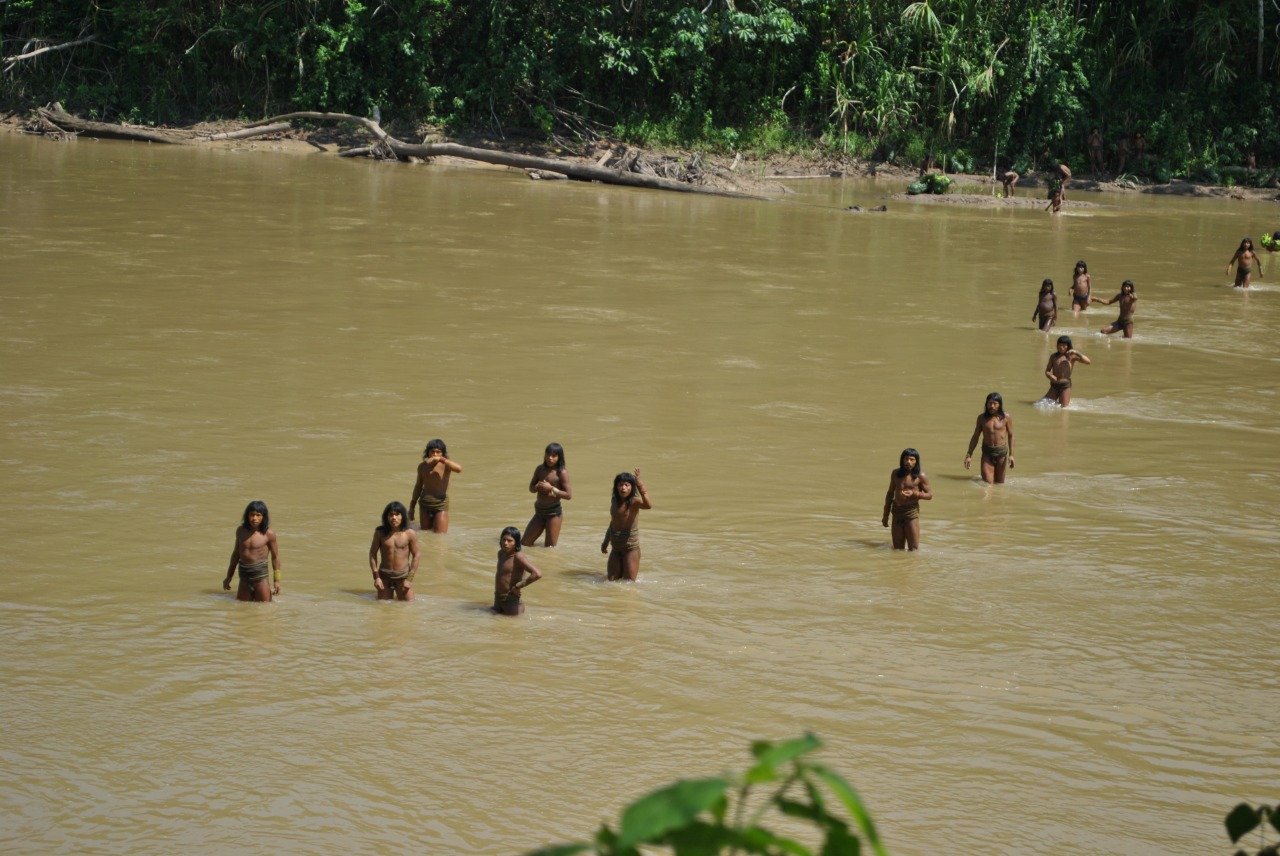
The Mashco Piro are an Indigenous people living in voluntary isolation throughout a cross-border territory in the southeastern Peruvian Amazon bordering Brazil. The presence of timber concessions, infrastructure projects, and illegal logging and mining activity pose serious risks to the Mashco Piro, harming the ecosystem they depend on for their survival and creating exposure to common diseases that for them are potentially lethal.
After decades of a lack of protection by the Peruvian State, FENAMAD and EarthRights International alleged violations of the rights of the Mashco Piro before the Inter-American Human Rights System. The case was admitted by the Inter-American Court of Human Rights (IACtHR) in 2024 and is now awaiting a hearing.
Background
Since the 1990s, the Native Federation of the Madre de Dios River and Tributaries (FENAMAD)—an Indigenous organization from the Peruvian Amazon—has raised alarms regarding the threat to the lives and integrity of the Mashco Piro people posed by the expansion of extractive activities.
In 2005, FENAMAD requested urgent protection from the Inter-American Commission on Human Rights (IACHR), which issued precautionary measures in 2007 to safeguard the lives and integrity of the Mashco Piro.
Given the ongoing emergency situation, FENAMAD filed a petition with the IACHR in 2011. In 2022, the IACHR concluded in Report 397/22 that the Peruvian State had violated the Mashco Piro people’s rights to collective property, judicial guarantees and protection, freedom of expression, self-determination, and political and cultural rights.
Despite the recommendations issued by the IACHR in this report, the Peruvian State failed to adopt effective measures to demarcate and adequately protect the territory, halt extractive activities, prevent forced contact, and establish a sanitary cordon to ensure the survival of the Mashco Piro.
The case was referred by the IACHR to the Inter-American Court of Human Rights in 2024, making it the first case before this tribunal concerning violations of the rights of Indigenous peoples in isolation in Peru. Currently, the date for the hearing is pending.
Timeline
The 1990s
FENAMAD took action to promote the creation of a territorial reserve to protect the indigenous peoples living in isolation in Madre de Dios. This initiative included a request to designate an intangible area for their protection, but the request was rejected by the State.
2002
The Peruvian State established the Madre de Dios Territorial Reserve with arbitrary boundaries and an area smaller than that requested by FENAMAD, even excluding some zones with a documented presence of peoples living in isolation. These territories were designated as “Protected Natural Areas” and “Permanent Production Forests”—classifications that still authorize extractive activities by logging companies and thus pose a grave risk to the lives and integrity of the Mashco Piro.
2005
FENAMAD requested urgent protective measures from the Inter-American Commission on Human Rights (IACHR) to protect the lives and integrity of the Mashco Piro people.
2006
On April 24, the Congress of the Republic of Peru passed Law No. 28736, known as the Law for the Protection of Indigenous or Native Peoples in Situations of Isolation and Initial Contact (PIACI). However, the law permits the exploitation of natural resources in these territories if declared a matter of “public necessity,” even when such areas overlap with the territories of peoples living in isolation.
2007
The Inter-American Commission granted precautionary protection measures to the Mashco Piro people, which remain in effect.
2011
Given the ongoing emergency situation, FENAMAD filed a petition with the IACHR.
2015
In response to pressure from FENAMAD and various other Indigenous organizations, the Peruvian State began the process to designate the territory inhabited by the Mashco Piro people as an Indigenous Reserve. A government technical study determined that extractive activities are incompatible with protecting the lives of the Mashco Piro, as they violate the “principle of non-contact.”
2016
The Multisectoral Commission gave their majority approval to the reserve proposal presented by the Ministry of Culture. However, the process did not move forward due to challenges and opposition from certain sectors of the State.
FENAMAD and AIDESEP called on the State to implement special protection measures in response to the expansion of extractive activities and deforestation in the territory.
EarthRights began supporting the case as a co-petitioner before the Inter-American Human Rights System.
2021
On March 19th, during the 29th session of the Multisectoral Commission, a proposal for an Indigenous Reserve was presented that included forestry concessions, thereby violating the principle of non-contact and restricting the participation of Indigenous organizations. In response to this situation, FENAMAD and EarthRights issued an alert calling for urgent intervention by the IACHR to protect the Mashco Piro.
On June 23rd, a hearing was held before the Inter-American Commission on Human Rights (IACHR) regarding the violation of rights and the lack of protection policies for the Mashco Piro, Yora, and Amahuaca Indigenous peoples living in isolation in Peru.
2024
The Inter-American Commission on Human Rights submitted Case No. 13.752 to the Inter-American Court of Human Rights, having found the Peruvian State responsible for violating the rights to: judicial guarantees, freedom of expression, collective property rights, political rights, judicial protection, and cultural rights, to the detriment of the Mashco Piro, Yora, and Amahuaca peoples.
2025
Following the enactment of Law 32301 (the “Anti-NGO Law”) on April 14th, EarthRights and FENAMAD requested provisional measures from the Inter-American Court of Human Rights (IACtHR) to continue their legal defense of the Mashco Piro people against the Peruvian State.
On July 8th, the IACtHR ordered the Peruvian State to refrain from sanctioning the organizations. That same day the Statement of Application, Argument, and Evidence (ESAP) was filed, ensuring the continuation of the case before the Court.
Documents
Case of the Mashco Piro, Yora and Amahuanca Peoples vs. Peru
Hearing before the IACHR – Case of the Mashco Piro, Yora, and Amahuanca Peoples vs. Peru
Request for IACHR intervention in the categorization process of the Madre de Dios Indigenous Reserve