By Variya Theppooviang*
At the end of 2017, I joined a cohort of participants for the Mekong Legal Advocacy Institute (MLAI) training, a key part of EarthRights International’s legal program. MLAI is a space for junior public interest lawyers and community legal/policy advocates from Mekong region countries to learn more about human rights and environmental issues. The program brought fifteen participants from six countries to Chiang Mai for a two-week program.
During MLAI, participants learn about land rights, development finance and investment, corporate accountability and how to co-power legal action with communities. They learn skills around legal campaigning, Environmental Impact Assessments and national and international human rights mechanisms. Participants gain specific expertise in the UN Guiding Principles on Business and Human Rights (UNGPs), operational grievance mechanisms, the Mekong River Commission and ASEAN frameworks.
“The MLAI course is very useful,” said Kam Tamee, a participant from Thailand. “It’s not only legal training or learning about our neighboring countries’ problems. We also build new relationships, new connections. We have many plans to work together in the future. I’m fortunate to attend the MLAI program. I got new experiences, great memories with friends, and my English skill is better than before.”
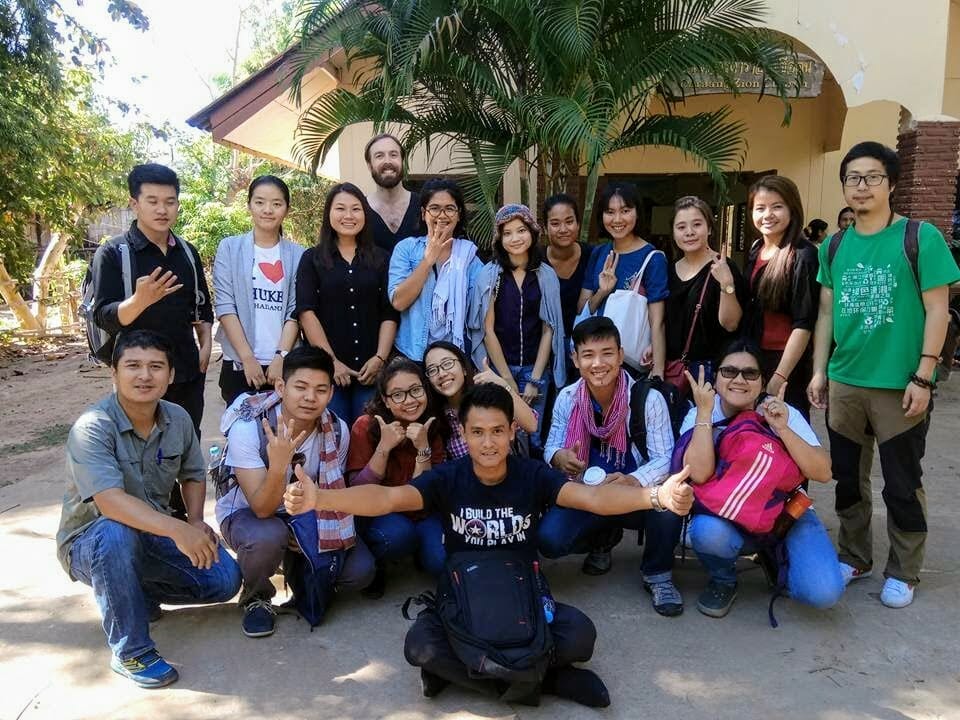
Participants in the 2017 Mekong Legal Advocacy Institute took a trip to a community in northern Thailand to learn about land rights and other legal issues facing local advocates.
In my view, I’m happy to participate in MLAI because firstly, I can practice many skills. In the legal part, I learned about environmental management law and constitutional law in Mekong countries. I also practiced skills around development finance accountability strategies used by expert organizations. Secondly, there was a chance to have an exchange with Mr. Ekachai Pinkaew, an officer at the National Human Rights Commission of Thailand. Lastly, I practiced English skills and gained confidence to give my opinion in class, all while building friendships with other participants.
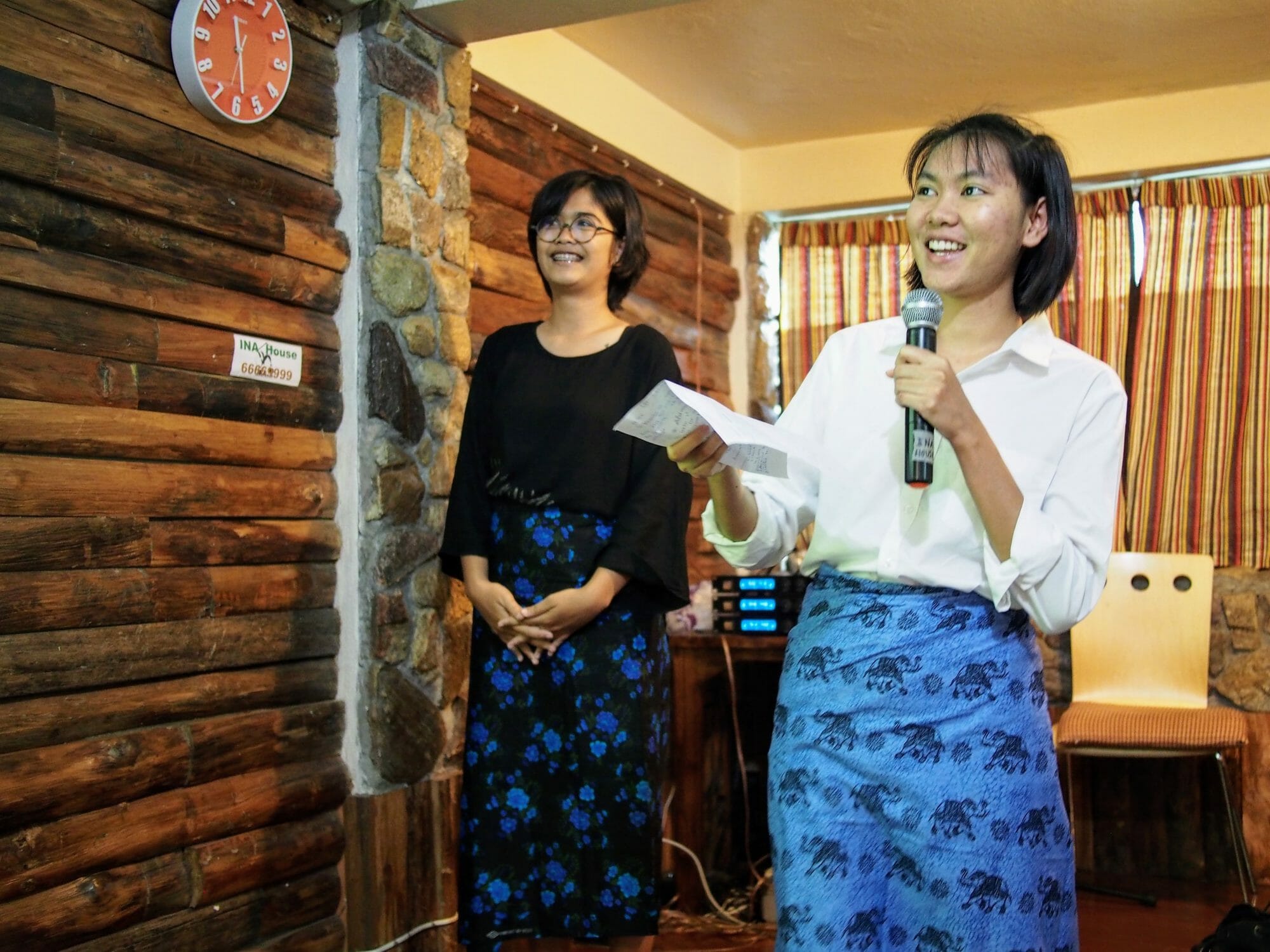
ERI Legal Intern Variya Theppooviang presents at the 2017 Mekong Legal Advocacy Institute.
The program also includes an exchange program with senior lawyers who are members of the Mekong Legal Network (MLN) and EarthRights School (ERS) students, which is good experience to bring knowledge to adapt for use in my current work and in the future.
Outside the classroom, participants have opportunities to learn about one another’s languages and food, and to build relationships with one another.
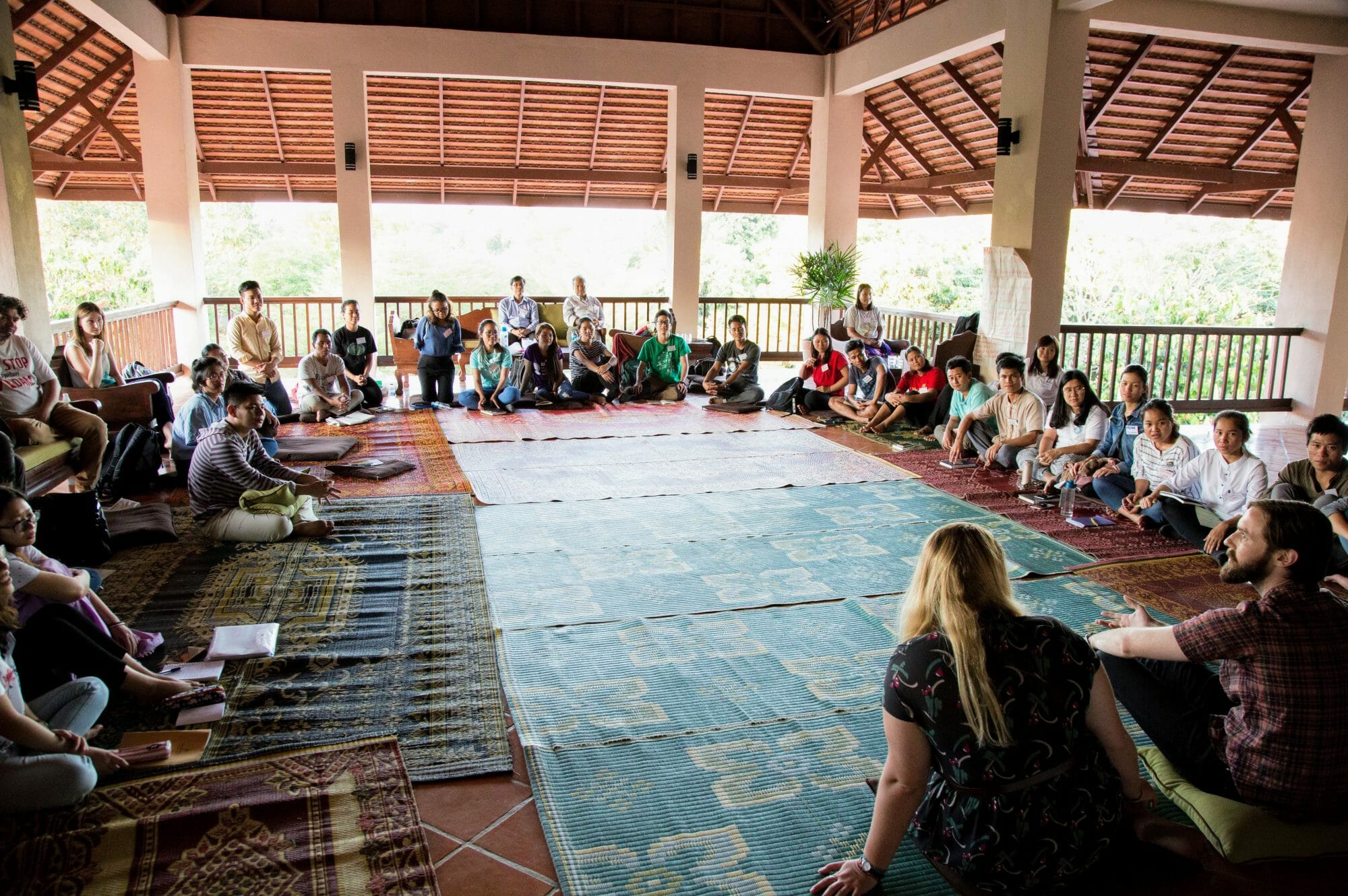
Participants in the 2017 Mekong Legal Advocacy Institute exchange experiences and case studies with students from the EarthRights School and senior lawyers from the Mekong Legal Network at the Mitharsuu Center.
The MLAI program also included a field trip to bring trainees to Baan Pang Dang, Chiang Dao District, where the Palong or Daraang community is facing land rights and citizenship issues. We went to Pang Dang village to learn and exchange with community members about problems they face with citizenship. Some of them don’t have Thai citizenship even though they have lived here for a long time. The authorities arrested community members three times because they live in a nature conservation area. On the field trip, we spoke with a representative from an indigenous NGO that works with the affected communities, and with two members from the affected villages. On the field trip, we also visited Chiang Dao Cave and Doisuthep Temple, one of Chiang Mai’s landmarks.
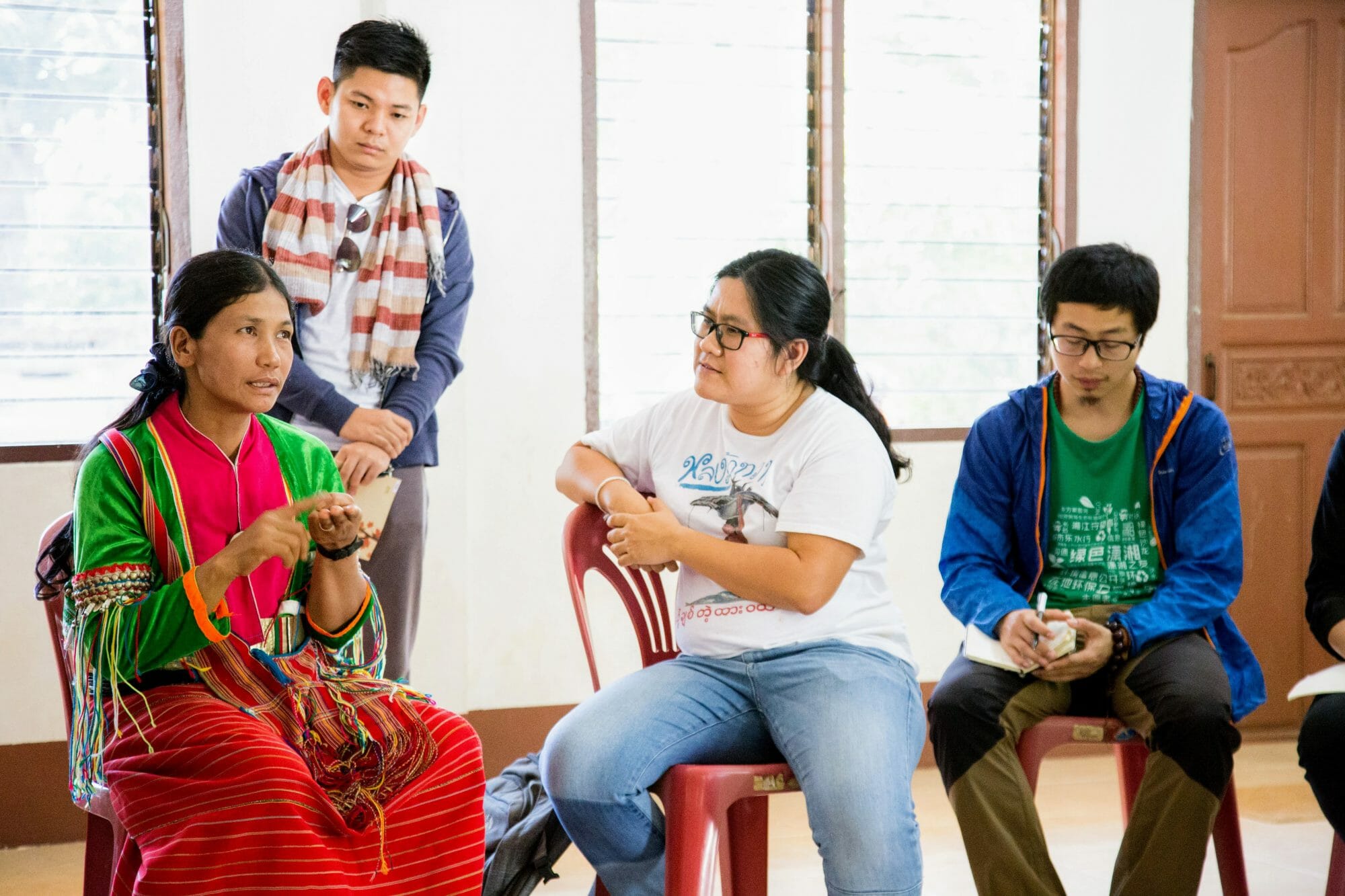
Participants in the 2017 Mekong Legal Advocacy Institute speak with villagers in a community in northern Thailand to learn about the legal challenges they face, including threats to their land rights and citizenship issues.
Participants also brought their own case studies to MLAI, such as that of a banana plantation using a lot of chemicals in Laos, Thepha coal power plant in Thailand, Heinda tin mine in Myanmar, Sambor mainstream dam in Cambodia, a marine life disaster in Vietnam, and garbage incineration power plants in China.
Nom Sotharoth, a participant from Cambodia, said: “Joining MLAI training has helped me gain knowledge on legal mechanisms and advocacy, which make me confident to share and apply my knowledge that I have gained to my community.”
MLAI is such a strong program, not only for knowledge on law but also on campaigning. Furthermore, there were lunches and dinners together for making relationships between EarthRights staff, EarthRights School students and participants. As a participant, I learned a lot of things that I cannot get from a classroom; I had awesome experiences, made new friends from many countries and learned about different cultures that I’ve never known before.
As one participant put it, “MLAI is a new learning space. I learned about problems from each country in the Mekong region, especially human rights violations. I also learned mechanisms to solve these problems, international issues and strategies to solve human rights and environment problems that I can apply in my country.”
*Variya is the Legal Intern in ERI’s Thailand office.
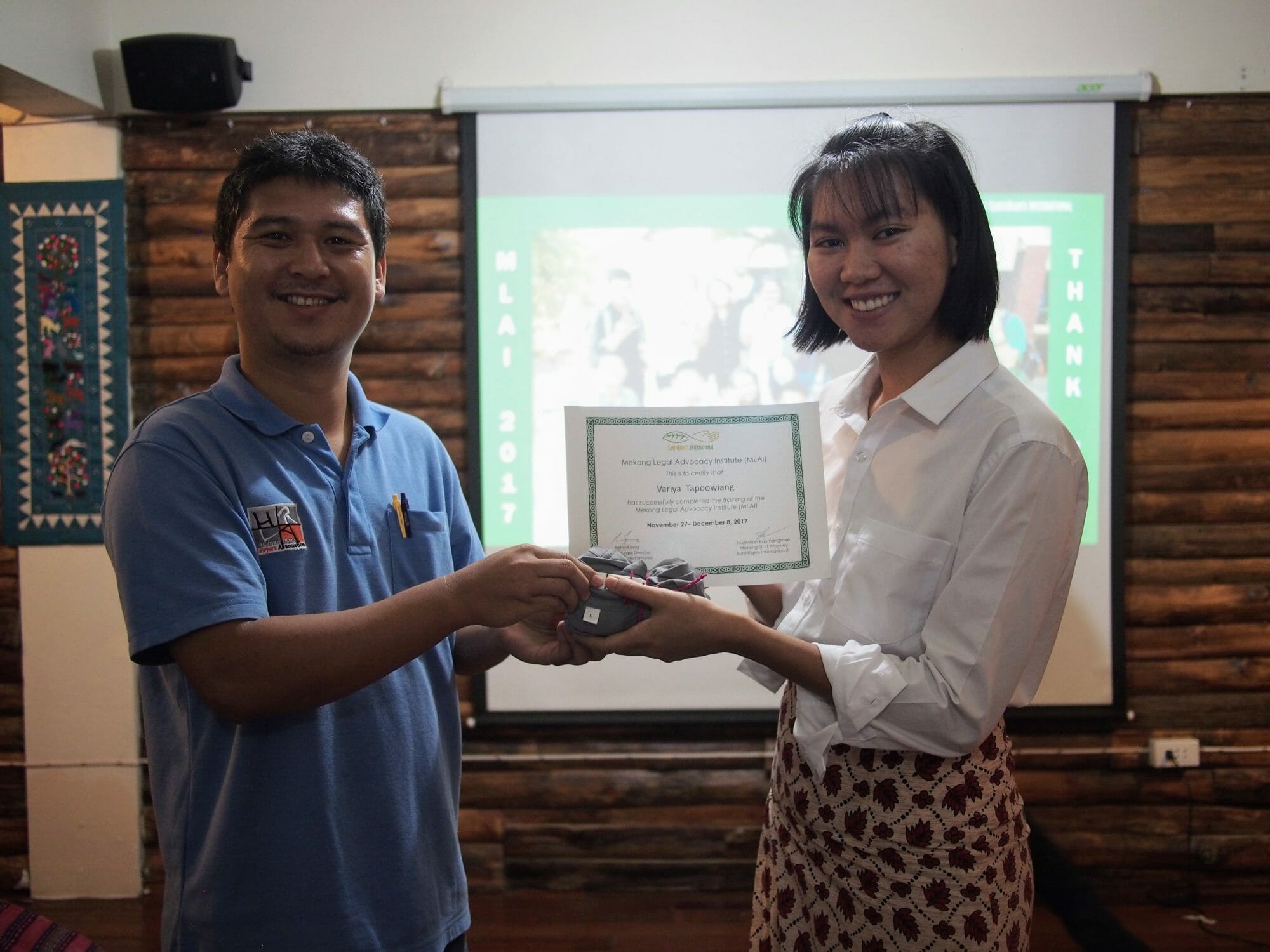
ERI Legal Intern Variya Theppooviang at her graduation from the 2017 Mekong Legal Advocacy Institute with Neung, ERI’s Mekong Legal Associate.