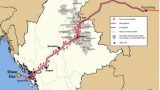
On Tuesday, the Shwe Gas Movement released a new report linking the Shwe natural gas and Burma-China crude oil projects to serious abuses across a huge area of Burma: Sold Out, Launch of China pipeline project unleashes abuse across Burma. The report highlights human rights and environmental abuses related to the natural gas and crude oil projects, as well as the increased tensions and fighting that have recently erupted around project construction areas in Shan State and close to the border of Kachin State.

The projects involve widespread land confiscation in processes totally lacking in the free, prior and informed consent of the local people. When I travelled to Arakan State to interview local people affected by land confiscation, they expressed a lot of anger towards the companies and the Burmese government officials conducting the land confiscation. They are angry about not being provided with information about the land confiscation process, no opportunity to refuse to sell their land, and insufficient compensation that cannot compare to or replace a lifestyle of supporting themselves by farming the land. They do not know how they will survive after the compensation money runs out – they have no business experience, and few opportunities to find work close to their native land.
One villager on Maday Island (in Arakan State) refused to sell his land, and as a result was beaten and seriously injured, and in the end still had to sell his land. To improve the land confiscation process the companies and the Burmese government should: ask for the free, prior and informed consent of the local people; pay compensation money directly to the local people to decrease corruption; create skills training and job opportunities (in the same area as the confiscated native land) for the local people who can longer support themselves from farming; and provide advice about how to manage the compensation money.
In addition to unfair land confiscation, Sold Out highlights a number of human rights and environmental abuses related to the projects including very serious fighting along and near the route of the natural gas and crude oil pipelines in Shan and Kachin States. The fighting began when the Burma Army launched offensives against the Shan State Progress Party (formerly Shan State Army-North) in March 2011, and the Kachin Independence Army in June 2011 – these battles have left an estimated 50,000 people newly displaced. Other abuses SGM found include poor labor conditions, displacement and labor migration, restrictions on fishing and related arbitrary taxes, forced labor, women’s rights, and the destruction of forests and coral reefs which has damaged the habitats of many species. Many of these abuses are also discussed in our March 2011 report The Burma-China Pipelines, Human Rights Violations, Applicable lab, and Revenue Secrecy, as well as recent blog posts.