Header Photo credit: Giniw Collective
SUMMARY
This case seeks to vindicate the rights of Indigenous water protectors and their allies in northern Minnesota who have faced unlawful and discriminatory policing and abuses in response to their constitutionally-protected opposition to the construction of Enbridge Inc.’s new Line 3 pipeline.
The proposed new pipeline would extend approximately 338 miles through northern Minnesota, carrying a projected 760,000 barrels of tar sands oil each day across 227 lakes and rivers (including the Mississippi River), over 800 protected wetlands, and ceded lands where Red Lake Band of Chippewa Indians and White Earth Band of Ojibwe exercise hunting, fishing, and gathering rights pursuant to treaties and recognized by federal law. The pipeline would destroy culturally important wild rice beds, risk catastrophic spills, and significantly contribute to climate change, representing the equivalent of 50 coal plants worth of greenhouse gas emissions to the atmosphere. Enbridge is already responsible for two of the largest inland oil spills in U.S. history.
Indigenous water protectors and their allies have risen in opposition to this project. In response, local police and authorities, indirectly funded by Enbridge, have adopted a pattern of unlawful conduct to dissuade the water protectors from engaging in their constitutionally protected activity. Police practices have ranged from surveillance, harassment, and intimidation, to pretextual stops and arrests, to mistreatment during periods of detention and confinement.
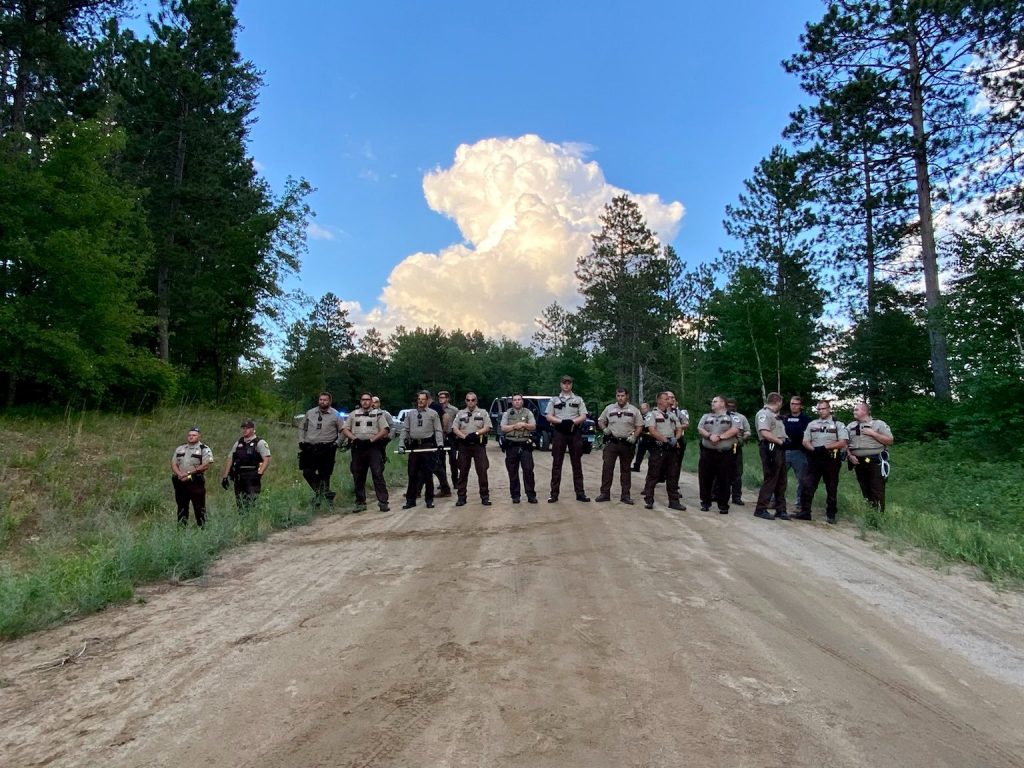
In an escalation of this months-long campaign, in June, the Hubbard County Sheriff’s department, with no notice, arrived with squad cars and riot lines of police and blockaded a longstanding driveway serving as the only means of entry and exit to the Namewag Camp — a convergence space and home for Indigenous-led organizing, decolonization and treaty rights trainings, and religious activities by water protectors seeking to defend the untouched wetlands and the treaty territory of Anishinaabe peoples. The Hubbard County Sheriff’s department has issued numerous citations and violently arrested persons seeking to use the driveway to bring food and water to the camp. The lawsuit seeks the immediate removal of the unlawful blockade and a declaration that all criminal citations for using the driveway are void.
Winona LaDuke is a renowned activist working on issues relating to sustainable development, renewable energy, and food systems. She is the co-founder and executive director of Honor the Earth. She lives and works on the White Earth reservation in northern Minnesota and is a member of the Mississippi Band Anishinaabeg.
AhnaCole Chapman is a resident of Rice County, Minnesota, and an ally to Indigenous water protectors opposed to the construction of the Line 3 pipeline through Indigenous treaty lands. Chapman was one of numerous individuals that received criminal citations for using the driveway.
Switchboard Trainers Network is a non-profit organization with headquarters in Denton, Texas, and the current title-holder of the property where the Namewag camp is located.
Corwin Aukes is the Sheriff of Hubbard County. Mark Lohmeier is the Land Commissioner for Hubbard County. Sheriff Aukes and Land Commissioner Lohmeier signed the undated, written notice informing the occupants of Namewag camp that the driveway would be blockaded. Sheriff deputies, under the direction of Sheriff Aukes, delivered the notice and implemented the blockade.
The legal action filed on July 16 argues that the blockade is a violation of private property rights, including, in particular, an easement covering the driveway to the property. It seeks the immediate removal of the blockade, an order preventing the defendants from ever reestablishing such a blockade, and a declaration that all criminal sanctions issued to individuals using the driveway are null and void.
TIMELINE
17th Century
The Anishinaabe Indigenous peoples, including the Ojibwe, had long lived in the upper Great Lakes region of what is now Canada and the United States, living a semi-nomadic life with a dependence on maple sap, fish, venison, and wild rice.
1830s through 1860s
With an increase of U.S. settlers encroaching on Anishinaabe land, the Anishinaabe peoples signed cession treaties with the United States government, by which large tracts of land were exchanged for promises of money, schooling, and goods. By the terms of the treaties, the Indigenous peoples retained the right to hunt, fish, and gather on the ceded (off-reservation) lands. These treaty rights continue to exist today, and the harvesting of wild rice continues to be a centerpiece of Anishinaabe culture.
1960s
The existing Line 3 pipeline was first built to carry oil from Edmonton, Alberta, to Superior, Wisconsin, passing through northern Minnesota.
1991
In March, the existing Line 3 pipeline ruptured near Grand Rapids, Minnesota, spilling over 1.7 million gallons of oil, much of which flowed into the Prairie River, a tributary of the Mississippi.
1999
In the case Minnesota v. Mille Lacs Band of Chippewa Indians, the U.S. Supreme Court reaffirmed the rights of Ojibwe peoples to hunt, fish, and gather on the lands it had ceded to the federal government in the 1837 and 1855 treaties against improper restrictions imposed by the state governments of Michigan, Minnesota, and Wisconsin.
2010
In July, a pipeline operated by Enbridge (Line 6B) broke, resulting in one of the largest inland oil spills in U.S. history, with over one million gallons of dilbit oil released into a tributary of the Kalamazoo River, displacing hundreds and requiring a multi year-long clean-up operation.
2014
Enbridge proposed constructing the new Line 3 “replacement” projected to carry 760,000 barrels of tar sands oil each day across 227 lakes and rivers (including the Mississippi River), over 800 protected wetlands, and through ceded lands where Red Lake Band of Chippewa Indians and White Earth Band of Ojibwe exercise hunting, fishing, and gathering rights pursuant to treaties and recognized by federal law.
Indigenous water protectors and their allies simultaneously began organizing in opposition and protest to the new Line 3 project for its threats to indigenous rights, water, and the climate.
2017
In February, water protectors set up the first Line 3 resistance camps in northern Minnesota.
2018
In June, the Minnesota Public Utilities Commission (PUC) voted to grant Enbridge a Certificate of Need for the new Line 3 pipeline and a Route Permit for the proposed path. In July, legal actions were filed challenging these decisions, as well as the adequacy of the Environmental Impact Statement. Plaintiffs included the Red Lake, White Earth, and Mille Lacs Bands, the Minnesota Department of Commerce, Honor the Earth, Youth Climate Intervenors, Friends of the Headwaters, and the Sierra Club. In September and October, the PUC issued a new Certificate of Need and a new Route Permit reflecting a changed path.
2020
In May, the Minnesota Public Utilities Commission (PUC) issued a decision granting Enbridge’s pipeline routing permit subject to a series of conditions. In accordance with the terms of the permit, Enbridge established a “Public Safety Escrow Trust” from which police can seek reimbursement for Line 3 related activities and made an initial deposit of $250,000.
In November, the Minnesota Pollution Control Agency (MPCA) issued water crossing permits for the pipeline. In response, twelve members of the agency’s Environmental Justice Advisory Group collectively and publicly resigned, citing concerns for climate change and violations of treaty rights, and arguing that they “cannot continue to legitimize and provide cover for the MPCA’s war on [B]lack and [B]rown people.”
In November, the United States Army Corps of Engineers issued important permits authorizing aspects of the construction of the new Line 3 pipeline. In December, the Red Lake Band of Chippewa Indians, the White Earth Band of Ojibwe, Honor the Earth, and the Sierra Club, filed a lawsuit in the United States District Court for the District of Columbia challenging those permits and seeking a preliminary injunction that would halt construction.
In December, Enbridge began construction on the new Line 3 pipeline.
2021
On February 7, the United States District Court for the District of Columbia denied the motion for a preliminary injunction filed in the case against the United States Corps of Engineers.
By the end of May, through the Public Safety Escrow Trust, Enbridge had reimbursed the police for over $1 million of effectively private security services.
On June 14, the Minnesota Court of Appeals upheld the Public Utilities Commission’s 2020 approval of the Certificate of Need, Route Permit, and Environmental Impact Statement for Enbridge’s Line 3 pipeline.
On July 16, Tara Houska, Winona LaDuke, AhnaCole Chapman, and Switchboard Trainers Network filed a lawsuit against the County of Hubbard, Corwin Aukes, and Mark Lohmeier in the Ninth Judicial District Court for the State of Minnesota seeking the removal of the unlawful blockade of Namewag camp. With their filings, they sought an immediate temporary restraining order against the defendants.
On July 23, the District Court granted the Plaintiffs’ request for a temporary restraining order, requiring the police to remove their blockade and to stop issuing criminal citations for the water protectors’ use of the driveway.
2022
In early September 2022, the Court granted summary judgment to the Plaintiffs, making the temporary restraining order permanent and ruling that: “Defendants are barred from preventing ingress and egress over the easement based upon any claim or theory that the easement is a trail and not an appurtenant easement.”
DOCUMENTS
Verified Complaint (July 16, 2021)
Order Granting Temporary Restraining Order (July 23, 2021)
Summary Judgement Decision (September 7, 2022)