SUMMARY
In 1998, in response to environmental and economic damage caused by Chevron’s oil producing activities in their communities, members of the Ilaje ethnic group in Nigeria organized a protest at a Chevron offshore oil platform. The Ilaje took small boats out to the platform and staged a nonviolent occupation; they were unarmed and no oil workers were harmed. In fact, armed Nigerian navy personnel remained at the platform throughout the protest. An internal Chevron memo sent the day after the protest started noted that the protestors “have thus far been peaceful.” A fax sent to the U.S. embassy the next day noted that the “villagers were unarmed and the situation has remained calm since their arrival.” But that same evening, Chevron called in the brutal Nigerian “mobile police,” known as the “kill and go” squad. The next morning, soldiers and police paid by Chevron arrived in Chevron helicopters, and shot and killed two protestors – one with four shots to the back, another with three shots to the side, according to autopsies. More protestors were arrested, and some were tortured. Chevron noted that the military was “closely supervised by” Chevron’s security personnel.
We sued Chevron in California for its complicity in these abuses, and brought the case to trial in 2008. This was the first time a multinational oil company had faced trial on charges of serious human rights abuses, an important milestone in international human rights law and corporate accountability. Unfortunately, although the judge had found that there was enough evidence to allow a jury to find Chevron liable for the human rights abuses suffered by the plaintiffs, in November 2008 a jury found that Chevron was not responsible.
This case was significant as one of the only Alien Tort Statute (ATS) cases against a corporation to reach trial. Along the way, the court rejected a number of commonly-raised defenses, including the act of state doctrine, forum non conveniens, secondary liability for violations of international law, corporate responsibility under the ATS, and the actionability of a number of norms of international human rights law, including extrajudicial killing, torture, and cruel, inhuman, and degrading treatment. The case was first heard by Judge Charles Legge, and later taken over by Judge Susan Illston.
TIMELINE
1998
After 30 years of oil exploration and production by Chevron (and its predecessor Gulf Oil), members of the Ilaje ethnic group organized to challenge the company. In early May 1998 the Concerned Ilaje Citizens, including Larry Bowoto, sent local officials an extensive report detailing the various damaging effects of oil production – including the contamination of drinking water through saltwater intrusion, destruction of aquatic life in the local creeks, disruption of ecosystems by explosives, acid rain from gas flaring, and erosion threatening villages. The report, entitled “The Marginalisation of the Ilajes,” also noted that their community had not benefited from Chevron’s presence; of almost 2,500 Chevron employees in Nigeria, only one was Ilaje. The report also noted that the Ilajes were peaceful and sought dialogue, while demanding environmental remediation, health centers, and greater employment and educational opportunities.
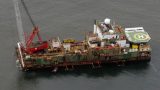
With no satisfactory response, on May 25, a group of Ilajes took small boats out to occupy Chevron’s Parabe platform and an adjacent construction barge. No oil workers were harmed throughout the occupation. On May 26 and 27, Chevron personnel repeatedly told both Chevron officials and the U.S. government that the protest was peaceful and the protestors were unarmed. At that point, the protestors had decided to leave in two days. But on the evening of May 27, Chevron called in Nigerian forces to evict the protestors. These included the mobile police, or “kill and go,” which had a brutal reputation and had committed some of the worst abuses against the Ogoni people. The soldiers and police arrived in Chevron helicopters on the morning of May 28, and shot and killed two protestors, shot and detained Larry Bowoto, and detained and tortured several others.
1999
ERI and its partners filed a lawsuit against Chevron in U.S. federal court in California, with claims of human rights violations under the Alien Tort Statute, as well as other claims such as wrongful death and assault. Chevron moved to dismiss, arguing that it was inappropriate to hear the case in the United States and that it should be heard in Nigeria.
2000
The judge denies Chevron’s attempt to dismiss the case, finding that the case could not be heard in Nigeria because Chevron Corporation was not willing to appear in court there. The parties proceeded to the discovery phase of the case.
2003
The court ruled that the plaintiffs’ claim for a violation of California’s unfair business practices law could not be litigated in federal court, due to federal standing rules. The plaintiffs re-filed this claim in California state court, seeking a court order that Chevron would need to change its business practices.
2004
The federal court denied Chevron’s motion for summary judgment, finding that there was sufficient evidence to hold Chevron responsible for the actions of its Nigerian subsidiary and personnel in Nigeria. The court also allowed the plaintiffs to add a claim for a violation of the Torture Victim Protection Act. In the related state court case, the judge denied Chevron’s motion to dismiss, rejecting Chevron’s arguments that its misleading public statements about the Parabe incident were protected by the First Amendment.
2006
The federal court dismissed the plaintiffs’ claim under the Torture Victim Protection Act, ruling that corporations could not be sued under that law. The court ruled that other claims could proceed. Chevron filed multiple motions for summary judgment to try to avoid trial.
2007
Although it found that a few claims could not proceed, the federal court largely denied Chevron’s last attempts to avoid trial, ruling that many claims were both legally sound and factually supported. The U.S. State Department submitted a letter to the state court, requesting that the court should not order Chevron to comply with the Voluntary Principles on Security and Human Rights, but that the government had no objection to other orders that the court might find appropriate.
2008
The case proceeded to trial in federal court in San Francisco. After several weeks of trial, the jury found that Chevron was not liable for the plaintiffs’ injuries. In the related state case, the judge denied Chevron’s attempt to dismiss the case.
2009
We filed an appeal with the Ninth Circuit Court of Appeals. Chevron demanded that the Nigerian plaintiffs repay some of its costs of litigation, but the judge denied this request, because the plaintiffs had no money and because “assessing costs . . . would have a chilling effect on future human rights litigants.” We agreed to dismiss the related state court case.
2010
The Ninth Circuit denied the plaintiffs’ appeal. Among other things, the court found that corporations could not be sued under the Torture Victim Protection Act.
2011
We filed a petition to the U.S. Supreme Court, seeking review of the question of whether corporations can be sued under the TVPA.
2012
The U.S. Supreme Court decided Mohamad v. Palestinian Authority, ruling that only individual humans can be sued under the TVPA. After this ruling, the Court denied the petition in Bowoto v. Chevron.
DOCUMENTS
Chevron-Marginalisation – May 1998
Chevron E-mail – May 26, 1998
Chevron Memo – May 27, 1998
Chevron 0407 Transcript – April 2000
Chevron 0512 Transcript – May 2000
Fourth Amended Complaint – August 2002
Bowoto v. Chevron Complaint – February 2003
Bowoto v. Chevron Original Complaint – February 2003
Complaint for Injunctive and Declaratory Relief – February 2003
Chevron Autopsies – September 2005
Order Granting Defendants’ Motion for Summary Judgment on Plaintiffs’ RICO Claims – March 2007
Order Denying Defendants’ Motion for Summary Judgment on Plaintiffs’ Tertiary Liability Theories – June 2007
Order Granting Leave to File Motion for Reconsideration – ATS Claims – August 2007
Order Granting Defendants’ Motion for Summary Judgment – August 2007
Order Re: Act of State – MSJ – August 2007
Order Re: Defendants’ Motion for Summary Judgment on Plaintiffs’ Claims 10-17 – August 2007
Order Re: Act of State Doctrine – November 2007
Bowoto v. Chevron Cert Opposition
Bowoto v. Chevron Ninth Circuit Court Opinion – September 2010
Defendants’ Answering Brief – December 2009
Chevron Order Denying New Trial – March 2009
Chevron Denial of Costs – April 2009
Order Re: Defendants’ Motion for Summary Judgment on Remaining Federal Law Claims – May 2008
Order Denying Defendants’ Motion to Continue Stay on “Subsequent Incidents” Discovery – January 2008
Order Denying Defendants’ Motion for Summary Adjudication – Availability of Injunctive Relief – January 2008
Opinion on Aiding and Abetting – August 2007
Opinion on Act of State Doctrine – August 2007
Tenth Amended Complaint – June 2008
Bowoto v. Chevron Petition for Writ of Certiorari – February 2011
Bowoto v. Chevron Reply Brief for the Petitioners – August 2011