
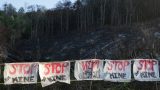
“We, the youth, locals, and community members of Omkoi are ready to stand up to fight and say ‘no’ to the coal mine that will [contribute to] climate change and [cause] the lands and lifestyles we’ve passed down from our ancestors to disappear.”
—Pornchita Fahpratanprai, Omkoi youth climate activist.
On April 4, members of the Kabeudin village, a Karen Indigenous community in the remote mountains of the Omkoi District of Chiang Mai Province, Thailand, filed litigation requesting that a faulty Environmental Impact Assessment (EIA) approved more than ten years ago without the participation of the community be revoked. The EIA authorized a new coal mine that would threaten the lives and environment of the community and contribute to the climate crisis. The community started organizing when it learned about the project in 2019, years after planning for the project began. Because of their organizing and opposition to the project, many community activists have been criminalized, as we recently revealed.
EarthRights International’s Frontlines of Climate justice campaign highlights frontline communities worldwide suffering the consequences of a climate crisis they didn’t cause who are also facing growing repression and violence due to their opposition to climate-damaging industries. Worldwide, corporations, governments, and financial institutions use a range of tactics to impose their projects on communities, conceal true costs to the public, exaggerate economic benefits, and exclude communities from decision-making processes.
The last two scientific climate change reports from the United Nations Intergovernmental Panel on Climate Change (IPCC), raised the importance of participatory decision making and participatory implementation of climate policies, especially in regard to mitigation policies to cut GHG emissions causing global warming. As the latest IPCC report from this month states, sustainable development cannot be achieved without reducing emissions and transitioning away from fossil fuels.
In the Omkoi district, the community identified that the coal mine would damage their health, water, and lands while increasing emissions that contribute to global climate change. As science is telling us that the window to act and avoid the worst impacts of the climate emergency is rapidly closing, it is shocking that States are still missing the political will to stop new fossil fuel infrastructure. It’s especially concerning that we haven’t addressed coal, as it is the fossil fuel that has contributed the most to global climate change. The burning of coal accounts for 46 percent of carbon dioxide emissions worldwide and 72 percent of total greenhouse gas (GHG) emissions from the electricity sector.
Around the world, frontline communities and climate defenders continue to demand change. The latest IPCC report on mitigation specifically shows that climate litigation is influencing policy development and increasing the ambition of climate governance. The Omkoi villagers suing Thai authorities are a true testament to this fact.
The Omkoi lawsuit is a new beginning in a long advocacy process the community started in 2019 when it first learned about the lignite mining project, despite the fact that the company 99 Thuwanon Co. Ltd. had spent more than 20 years planning it. When the community learned about the project in 2019, villagers organized a resistance process against the mine. They formed the Omkoi Anti-Coal Mine Network and started disseminating information about the project and its potential impacts. Their efforts have been heavily repressed and criminalized by the company and the government.
Seven protesters have been accused of defamation, and five youth activists were criminalized just for posting information on social media about the project, including four university students from Chiang Mai. Two Indigenous human rights defenders from nearby villages were charged because they gathered and disseminated anti-coal mine information. Despite the growing repression, villagers persevered in their organizing, and on April 4, more than 600 of them endorsed the lawsuit.
Scientists at the IPCC have loudly expressed that climate change is making our planet unlivable and that the time to act is now. Governments worldwide must take action to avoid climate catastrophe and human rights abuses brought on by continued dependence on fossil fuels. The IPCC has already provided scientific evidence on the causes of the climate crisis, the impacts, its ramifications on human rights, and how to address the crisis. We implore world leaders to raise their climate commitments.
However, no climate policy will be effective if those on the frontlines of the climate crisis still suffer violence and repression. As the climate crisis escalates, so does the harassment and criminalization facing frontline defenders. The UN Special Rapporteur on Freedom of Assembly documented such tactics in a report presented in 2021 to the UN General Assembly. The report specifically recognizes the important role of frontline communities and civil society to ensure a sustainable future and calls on States to guarantee the right to participate in environmental decisions and the right to freedom of association and assembly in the context of climate protests, including protests against commercial interests.
An effective response to the climate crisis must include measures to protect those demanding change and mobilizing to defend their lands. At global climate negotiations, there has been no mention of repression of the global climate movement and how it is impacting the adoption and implementation of climate policies. This must change.
At a minimum, governments should commit to respecting the rights to freedom of assembly and association of climate activists, Indigenous peoples, and frontline communities. This includes refraining from bringing spurious charges against community members who oppose fossil fuels or other development projects. The criminalization that has taken place at Omkoi must not be repeated.