Blogs

Congratulations to the 2010 Goldman Environmental Prize winners!

I always feel inspired at this time of year, when the Goldman Environmental Prize is announced and we have an opportunity to learn about the amazing achievements of environmental leaders throughout the world.  The Goldman Prize reminds me of the critical change that all of us can make — even those of us who often feel small or voiceless. I remember how I felt in 1999 when I received the Goldman Prize; that I had done nothing extraordinary at all, I had simply done what I had to do. I'm sure that this year's winners feel the same way:  overwhelmed, excited, humbled, and wondering "what's the big deal?" But there can be no bigger deal than protecting the planet and its people, ever since that time I've realized that everyone, whether they come from the jungle, the village, the mountains or the city, can be an environmental hero.

My friend Randall Arauz, who takes great risks to stop poachers from the cruel practice of shark finning in Costa Rica, is among this year's Goldman Prize winners. Thanks to his hard work, there is a new national fisheries law in Costa Rica requiring all sharks to be landed with their fins intact. Randall's bravery and commitment is truly extraordinary, but I can also tell you that he's a normal guy like all of us. It's been six years since we were roommates in London, when we both received a Whitley Award for Nature, but the jokes and good times we shared seem like they were only yesterday.  Congratulations, Randall — I hope we can celebrate together again sometime soon!

2010 Goldman Environmental Prize Recipients2010 Goldman Environmental Prize Recipients

ICJ Delivers Toothless Justice in Uruguay Paper Mills Case

The International Court of Justice handed down a troubling ruling this week in the case of Pulp Mills on the River Uruguay, a case in which Argentina contested Uruguay’s decision to allow the construction of highly polluting paper mills on the boundary river between the two countries without following proper consultative procedures.  In the ruling, the ICJ recognized that Uruguay had breached a treaty with Argentina and improperly authorized the construction of the mills, but found it unnecessary to order remediation, compensation, or mitigation measures for the pollution of the river.

The Centro de Derechos Humanos y Ambiente (CEDHA – Center for Human Rights and the Environment) has spearheaded Argentine resistance to the paper mills, whose effluents have further contaminated an already-beleaguered river and and whose emissions of air pollutants have impacted the recreational and tourism activities on which local Argentine communities rely.  CEDHA has covered the ICJ’s ruling in English and Spanish extensively, pointing out the disturbing role of the International Finance Corporation in financing the projects despite prior knowledge of numerous violations of environmental regulations and highlighting the dissenting opinion of Judge Yusuf Al-Khasawneh, which argued that the Court lacked capacity to evaluate highly technical environmental evidence and should have sought expert advice before rejecting Argentina’s claims.

A sign posted in a shop in Gualeguaychú, Entre Ríos, ArgentinaA sign posted in a shop in Gualeguaychú, Entre Ríos, Argentina, that reads NO A LAS PAPELERAS - SI A LA VIDA -

ERI on HuffPo: "The UN Singles Out Big Oil in Burma, With Good Reason"

Last week, The Huffington Post published my first post, “The UN Singles Out Big Oil in Burma, With Good Reason.” Even as we launch our own blog here at EarthRights International, we thought it was important to reach out to the millions of readers of HuffPo, as so much of our work relies on raising as much awareness as possible – of the general public, investors, policymakers, and others. This story in particular warranted an article because it marked the first time the UN Special Rapporteur on Human Rights (UNSR) in Burma named and shamed specific oil companies that are linked to serious human rights violations in the country. What’s more, it had been totally unreported in the local or international media.

In my post, I wrote:

While this is the UNSR’s first mention of the human rights impacts of foreign-led energy projects in Burma, at EarthRights International (ERI), we’ve documented for years how overland gas pipelines and other billion-dollar installations in the country are physically secured by the Tatmadaw – the Burmese Army – resulting in forced labor, killings in cold blood, rape, torture, and other abuses against local residents.  

I went on to amplify some of our urgent recommendations for South Korea’s Daewoo International, its partners from India and South Korea, and the China National Petroleum Corporation (CNPC). These companies are currently in the construction phase of a new gas pipeline to China, the Shwe pipeline, which is connected to serious human rights impacts:

Rather than move full speed ahead, Daewoo International, its partners, and CNPC should instead listen to the Shwe Gas Movement and EarthRights International: the companies should postpone the Shwe pipeline and any work on offshore installations until there’s no risk the project will contribute to human rights violations – that would be good business. In the meantime, the companies should promote public participation in development decisions; conduct transparent, inclusive third-party environmental and human rights impact assessments according to international standards; and practice complete revenue transparency, including publishing taxes, fees, royalties, bonuses, and social benefits paid to the Burmese authorities.

500 villagers take action on International Rivers Day

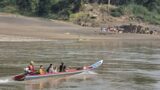
On March 13-14, I traveled to Mae Sob Moei, on the Thai Burma Border, at the confluence of the Moei and Salween Rivers. March 14 was International Rivers Day, and every year the local villagers gather at this beautiful junction of rivers and mountains to celebrate the source of their livelihoods, and to urge Thailand and Burma to call off their plans to build dams on the Salween River.

There were about 500 people there, from all along the Salween River; from the China Border in Shan State to the mouth of the Salween in Moulmein. There were also activists from the Mekong River in Thailand, telling their stories of flood and drought due, they believe, to upstream Chinese dams. The opportunities to share information and plan future collaborative activities were numerous. There is no doubt that this annual event strengthens the local communities’ will and contributes to a more sustained and coordinated approach to the concerns of impacted riparian communities.

Monks Praying on the Salween RiverMonks Praying on the Salween River On Saturday night, there was a concert and cultural exchange, with each ethnic group sharing a song or a story on a small stage. The musical style ran the entire spectrum, from quiet solo acoustic on traditional instruments to loud raucous Thai Electric Rock & Roll. All of the music was well-performed and well-received, and the crowd really took the stories to heart.

On Sunday morning a Ceremony to Celebrate the Salween River was held, with monks offering prayers, local and national human rights officials speechifying and offering their plans for action, and an opportunity for NGO’s throughout the region to learn and share information. The program concluded by late morning, as the fog lifted and the heat of the March day took hold.

Teaching HTML to Burma Activists

In late March, I led a one day workshop in basic web design at the EarthRights School Burma (ERSB), ERI's school for emerging activists inside Burma and along the Thai-Burma border. The course, taught at the students' request, consisted of a brief introduction to HTML and CSS. These two topics are far too complex to cover in a single session, so my modest goal was that the students leave the class with enough knowledge of syntax and workflows to begin to explore these technologies themselves, so that in time they might be able to contribute to the websites of whatever organizations they work with in the future.

The ERSB students have a tremendous range of technical backgrounds; some had scarcely used a computer at all before arriving at ERSB, while others rarely let their laptops out of their sight. This breadth of experience was difficult to negotiate, both in the HTML class and my previous class on digital security, but I was pleasantly surprised by both the enthusiasm with which many of the students approached our workshop, and their willingness to share and teach each other throughout the day.

One unexpected challenge, which in hindsight I should have anticipated, was the American-English bias of CSS (HTML shares this bias, but has a smaller vocabulary that is easier to memorize). More than once, perplexed students asked me why their "colour" property values weren't working. While "color" vs. "colour" is confusing enough, more advanced CSS properties include many words that the students either weren't familiar with or didn't find intuitive: "white-space," "text-decoration," "overflow," "vertical-align" and many more. Web languages have a strict syntax and vocabulary, and do not tolerate variations, so students who were fluent enough to communicate verbally in English nonetheless found themselves blocked at every turn by subtle points of spelling and word choice.

Burma ranked among 3 worst countries in 2009 Corruption Perceptions Index

This week, Transparency International released its 2009 Corruption Perceptions Index (CPI), a "composite index … based on 13 different expert and business surveys" that measures not corruption itself, "but the perceived level of public-sector corruption."

Burma (Myanmar), a perennial bottom-feeder since it was added to the CPI in 2003, this year came in 178th of 180 countries, besting only Afghanistan and Somalia, and scored a mere 1.4 out of 10 possible points.  

Nigeria, site of the tragic events behind the Wiwa v Shell case, which ended this year in a historic settlement, slipped from 121st to 130th after several years of improvement, but avoided reuniting with Burma at the bottom, where it spent the first half of the decade. However, Nigeria scored only 2.5 points of a possible 10, so its recent climb is hardly cause for celebration.

While the CPI does not disclose the precise numbers leading to each country's score, Transparency International's Huguette Labelle has counted the lack of "transparency in public budgets, revenue and aid flows" among the many factors contributing to corruption across the globe. Promotion of transparency is a common theme in many of EarthRights International's campaigns as well.

In our September 2009 report "Total Impact: The Human Rights, Environmental, and Financial Impacts of Total and Chevron’s Yadana Gas Project in Military-Ruled Burma (Myanmar)," ERI revealed how the Yadana gas pipeline has generated over US$7 billion, with a majority of these billions going to the Burmese military regime. We also reported that a significant portion of these revenues never make it back into Burma, but instead can be found squired away in non-government bank accounts in Singapore.

Pages

Subscribe to RSS - blogs