You are here
Teaching HTML to Burma Activists
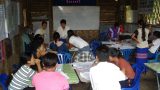
In late March, I led a one day workshop in basic web design at the EarthRights School Burma (ERSB), ERI's school for emerging activists inside Burma and along the Thai-Burma border. The course, taught at the students' request, consisted of a brief introduction to HTML and CSS. These two topics are far too complex to cover in a single session, so my modest goal was that the students leave the class with enough knowledge of syntax and workflows to begin to explore these technologies themselves, so that in time they might be able to contribute to the websites of whatever organizations they work with in the future.
The ERSB students have a tremendous range of technical backgrounds; some had scarcely used a computer at all before arriving at ERSB, while others rarely let their laptops out of their sight. This breadth of experience was difficult to negotiate, both in the HTML class and my previous class on digital security, but I was pleasantly surprised by both the enthusiasm with which many of the students approached our workshop, and their willingness to share and teach each other throughout the day.
One unexpected challenge, which in hindsight I should have anticipated, was the American-English bias of CSS (HTML shares this bias, but has a smaller vocabulary that is easier to memorize). More than once, perplexed students asked me why their "colour" property values weren't working. While "color" vs. "colour" is confusing enough, more advanced CSS properties include many words that the students either weren't familiar with or didn't find intuitive: "white-space," "text-decoration," "overflow," "vertical-align" and many more. Web languages have a strict syntax and vocabulary, and do not tolerate variations, so students who were fluent enough to communicate verbally in English nonetheless found themselves blocked at every turn by subtle points of spelling and word choice.
Back in Washington, DC, I crossed paths with an engineer with a linguistics background, and we discussed this particular language obstacle at length. We both agreed that it seemed ethnocentric and unjust to expect students from Burma to know and remember terminology like "text-transform," "padding-top" and "font-variant," in a context that tolerates neither misspellings nor synonyms. Would it make sense, we wondered, to create localized versions of the CSS standard, which could be translated into true CSS, so that people around the world could write code using familiar terminology in their mother tongue? Or would it be better to instead facilitate the translation of higher level software tools into local languages so that learning CSS, regardless of language, is less necessary? There are technical and logistical pros and cons to both options, but proponents of content management systems (CMSs) would likely advocate for the latter, arguing that higher level tools are more effective at raising voices, particularly those with limited access to technological expertise, because they allow individuals to focus on content rather than visual design and technical deployment challenges.
This perspective is consistent with my own experiences at EarthRights International. Since November, 2009, the EarthRights.org website has run on Drupal, and our alumni website uses Joomla; these are two of the leading open source CMS systems and, in comparison to technologies available a decade ago, they have exponentially increased our ability to not only keep our web content up to date, but also to integrate our web strategy with our social media strategy and to leverage the latest technologies and standards to help promote our work. The launch of the ERI blog is but one example of the opportunities these technologies provide: most of our internal planning meetings for the blog focused on content, and the technology was merely an afterthought, deployed after about one week of work.
Despite my excitement about our own improving e-communications, I can't help but feel there is something unjust about the present options, because neither Joomla nor Drupal is available in Burmese translation, let alone translated into any of the minority ethnic languages preferred by many of the groups we work with. This means that our ERSB alumni, whether their content is in English, Burmese, or a minority language, have no choice but to work with English language software when building or contributing to websites. Our ERSM (EarthRights School Mekong) students and alumni are somewhat better served by the tech community, as both Drupal and Joomla have at least partial translations for many of the official languages in the Mekong region, including Chinese, Vietnamese, Khmer, and Thai, but many of these translations are incomplete or outdated.
It is unclear whether Burmese translations are lagging behind due to the political or socioeconomic situation, technology infrastracture and access, or perhaps merely the technical quirks of Burmese Unicode, but it is clear that a sustained effort to overcome any translation obstacles is needed if our alumni are to ever have access to the same caliber of tools that we enjoy at ERI, in their preferred language.
The New York based NGO Digital Democracy recently took an important step in this direction, facilitating the partial translation of Ushahidi, a crisis mapping tool, into Burmese. A personal goal of mine is to show similar leadership, both in the Drupal community and in the regional NGO community, and eventually facilitate the complete translation of Drupal into both Burmese (starting from scratch) and Thai (building on existing efforts). If this goal is achieved, the capacity of regional NGOs and activists to build their own websites and raise their own voices, without relying on external technical support, will be greatly increased.


Join EarthRights International on Facebook