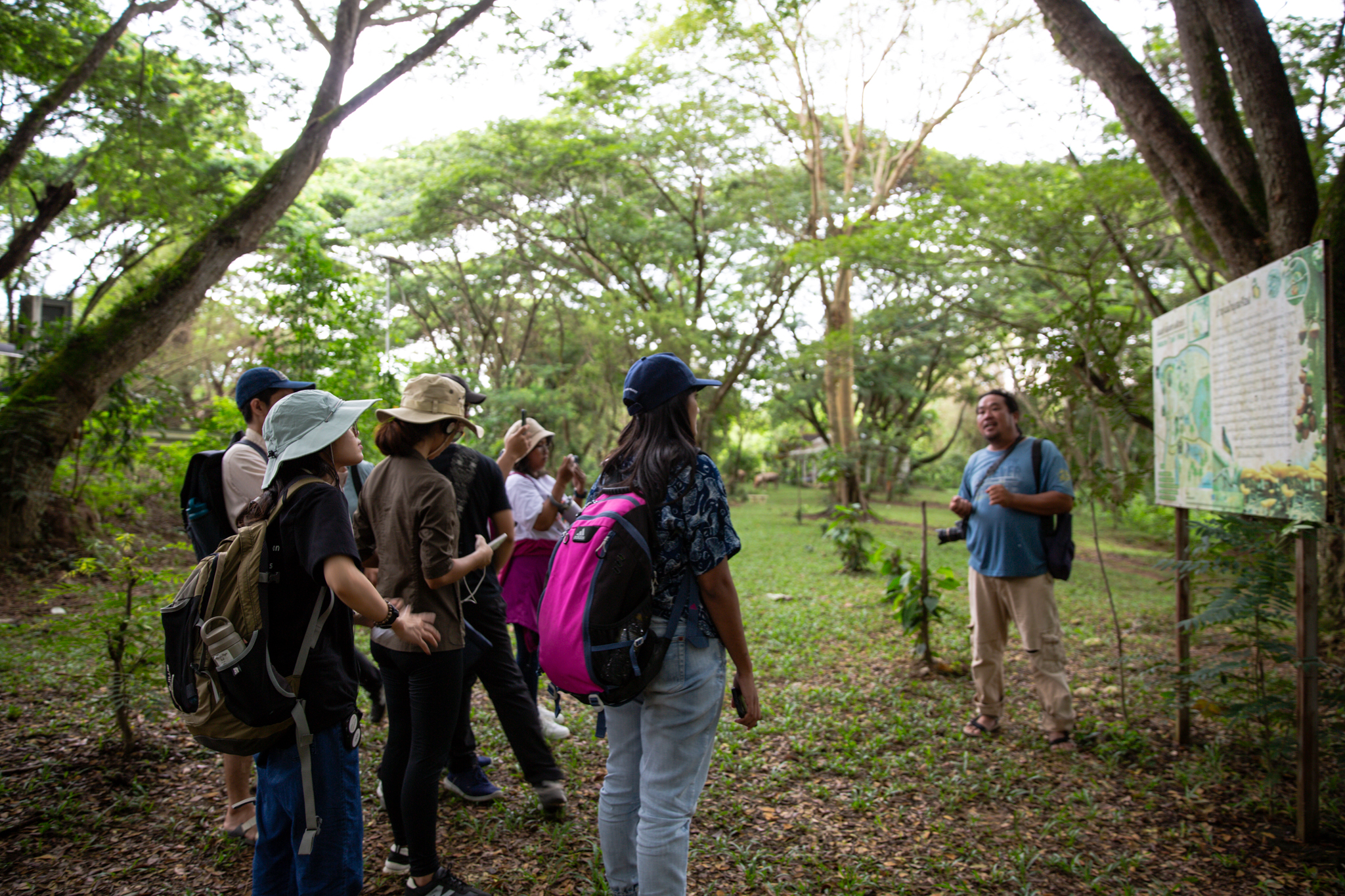
Last month, a group of staff and EarthRights School students embarked on a transformative journey with Mekong River communities in Chiang Rai, Thailand. The three-day learning field trip aimed to educate students on earth rights issues and the impacts of development projects on local communities along the lower Mekong basin.
The trip started with a five-hour, 300-kilometer journey from Chiang Mai to Ban Huai Luk, a village just a few meters away from the Mekong River. There, students met with several community members, including Phan, a former village leader.
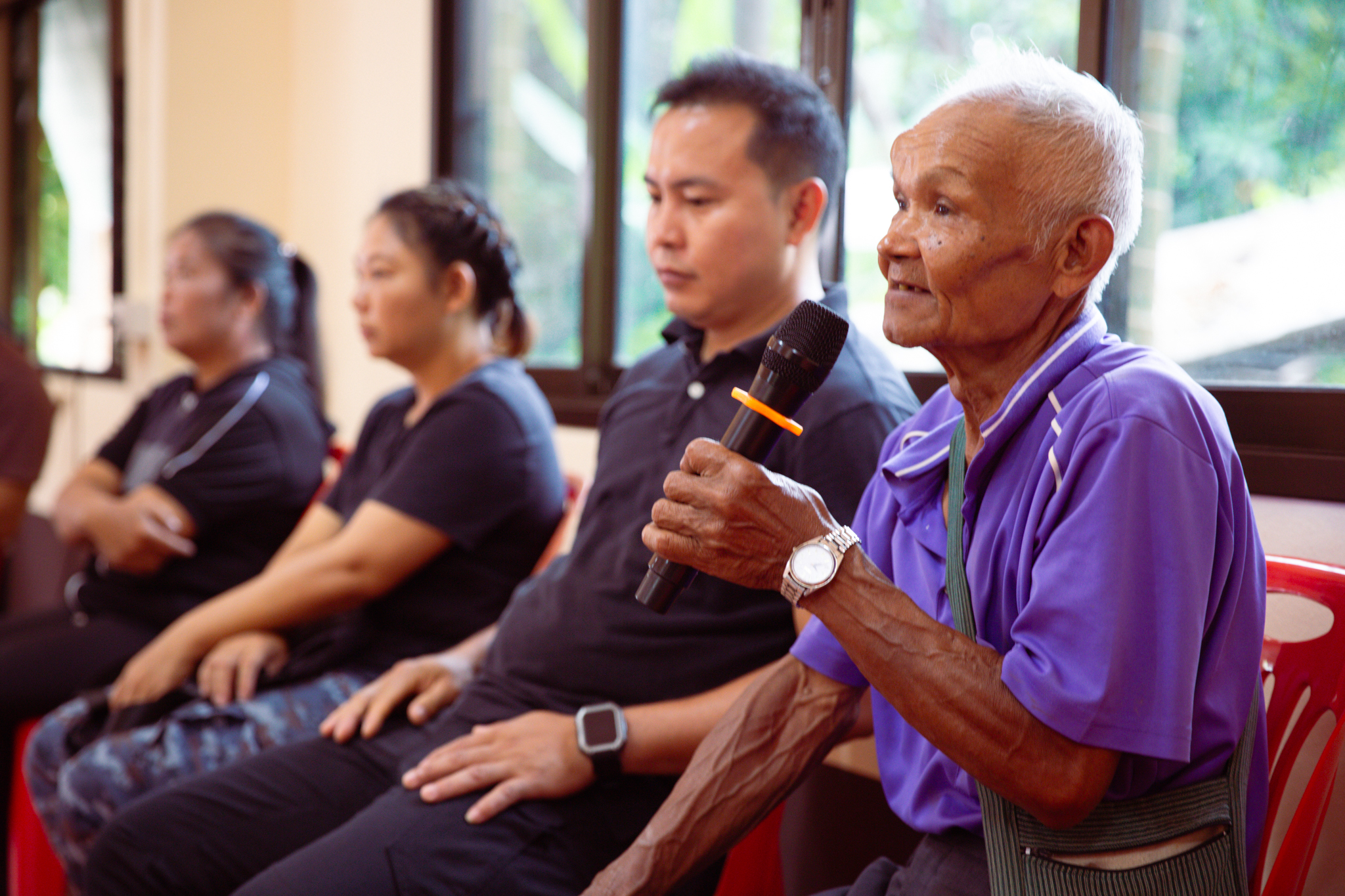
Villager Phan narrates how the dams impacted his livelihood.
Now 75 years old, Phan narrated how the dams along the Mekong River impacted his livelihood: “In the past, we were sufficient. After just two hours of fishing, I could get a bucket full of fish. But since the dam was built, I can’t get the same number of fish even if I do fishing for the whole day. It has made our livelihood difficult.”
Communities in northern Thailand have been experiencing transboundary impacts from dams on the Mekong River. These impacts caused sudden changes in water levels, flooding of riverbank gardens, drought, and loss of traditional fish catch. But, with more dam projects in the planning stages, including the Pak Beng Dam in Laos, local communities worry about how these new dams will significantly worsen the issues that they are already facing.
Ping Pha Pai, a community group leader for women, felt uncertain about her livelihood: “As a woman who supports family, I get my livelihood from the river. During the dry season, I collect seaweeds for food. I also sell seaweeds, and they give me an extra 10,000 baht income for two months. But if water is released from the dam, it will only take some hours for the water level to rise. It can go high; it’s dangerous. So, we can no longer collect seaweeds. All will be gone.”
Quick Facts: Lower Mekong Basin
65 million people rely on the river for their food and livelihoods
Provides $11 billion per year in economic benefits from fisheries
Home to over 1,200 species of fish and aquatic life.
To resist the building of dams, local communities, together with the Living River Siam Association, are working hard on their community-engaged research to show governments the impact of development projects along the Mekong River. The research tool that they use, Thai Baan Research, empowers villagers to document the relationships between biodiversity, culture, ecosystems, and livelihoods. It is widely seen as complementary to the scientific approaches that experts and academics use.
Pisanukorn, a staff of the association, briefed the students on the Thai Baan Research: “Community’s voices are important, but they are not included when EIAs [Environmental Impact Assessments] of development projects are conducted. Thus, we visit communities to train the locals on community-engaged research so they can collect information on local knowledge. The villagers use field surveys, group discussions, interviews, and photo documentation in this research methodology. Then, we use the research findings to support our claim.”
Although communities in Thailand have actively participated in community-driven research, this completely contrasts with what is happening in Laos, which lies just across the river, according to Apishit, an assistant village leader.
“People in Laos know their government will build more dams, but they don’t have more information. It is difficult to share information with them because the local communities can’t express themselves publicly. In Thailand, we get information from our networks. But in Laos, I think they can’t,” he said.
The Mekong School in Chiang Khong
After we spent a night at Ban Huai Luk, we said our farewell to the local villagers and traveled to the Thai border town of Chiang Khong. The riverside town is a busy and popular gateway among locals and foreigners traveling to Laos.
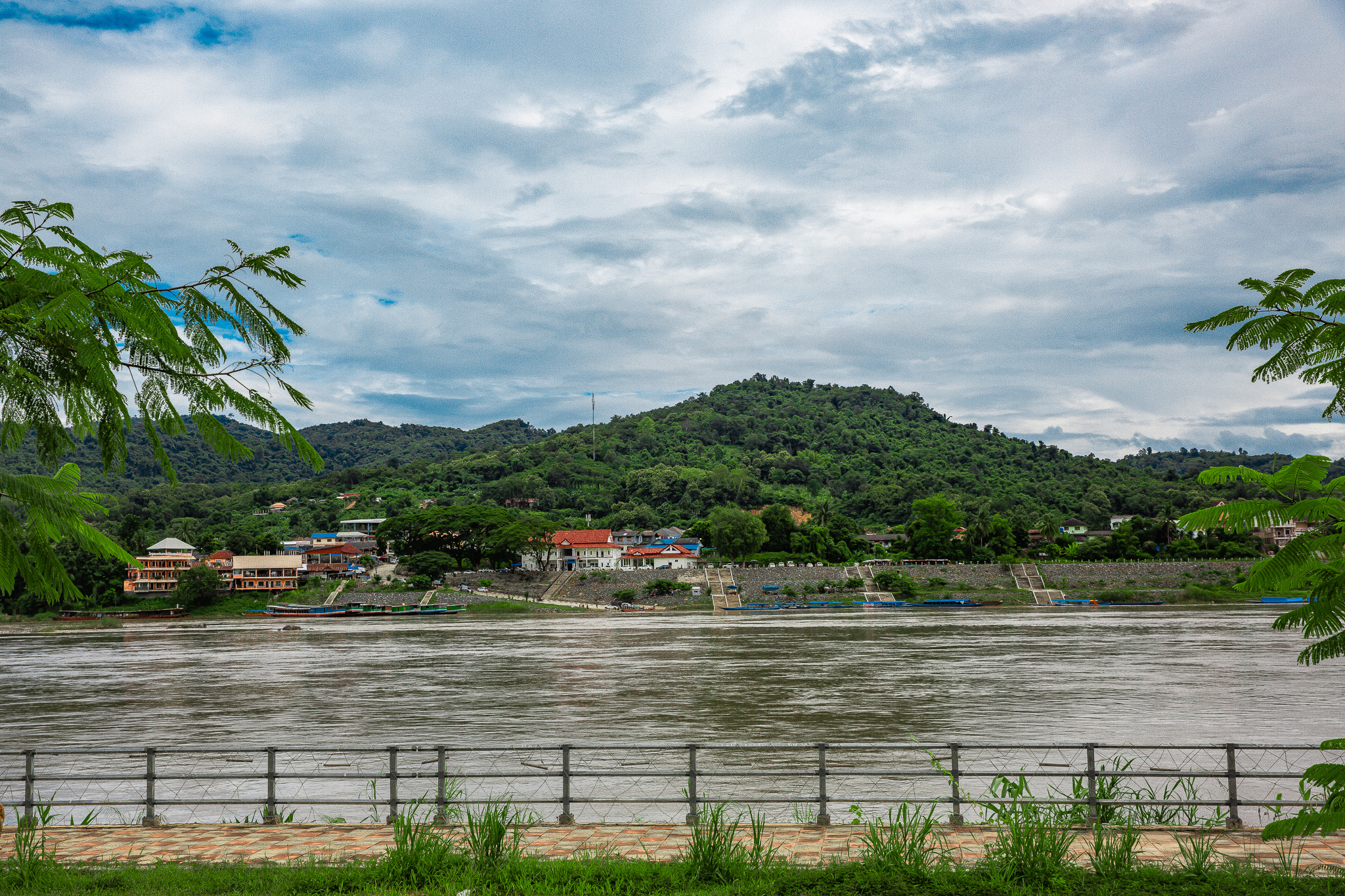
Photo taken from the town of Chiang Khong, which is overlooking Laos.
We spent two days in Chiang Khong. There, we met with Niwat “Kru Tee” Roykeaw, an earth rights defender who received the Goldman Environmental Prize in 2022. He welcomed us to the Mekong School in Chiang Khong, an educational space he founded in 2015 for local people and youth to learn more about the environment and culture of communities along the Mekong River, and the impacts of development projects.
Kru Tee explained why he established the school: “We have collected information and books here. We hope these learning tools will help you learn more about the Mekong River. I believe in the young generation and their power.”
Kru Tee plays a crucial role in stopping development projects in the Mekong River. One of the many successful campaigns he led in the past was against the planned blasting of rocky sections along the Mekong River to make way for large Chinese ships traveling down the river.
“The project developers were only concerned with improving the navigation of large ships in the river, but they failed to consider that the rocks serve as a habitat and breeding grounds for fish. Blasting them will result in a decline in fish stock, eventually affecting the local communities,” he said.
To make the public aware of the planned project’s impacts, Kru Tee and other earth rights defenders produced publications, disseminated information through the media, and organized protests that mobilized the people to support their cause. Ultimately, the Thai government canceled the project in 2020 due to its potentially harmful environmental and social impacts. The project’s cancellation marked a rare win for the environment in the region, which is currently facing substantial pressure from development projects.
Ban Boon Rueang Wetland Forest
After the learning session with Kru Tee, we traveled to the next location to learn about another successful case of a community that saved a wetland forest from environmental exploitation. It took us an hour to reach the Boon Rueang Wetland Forest.
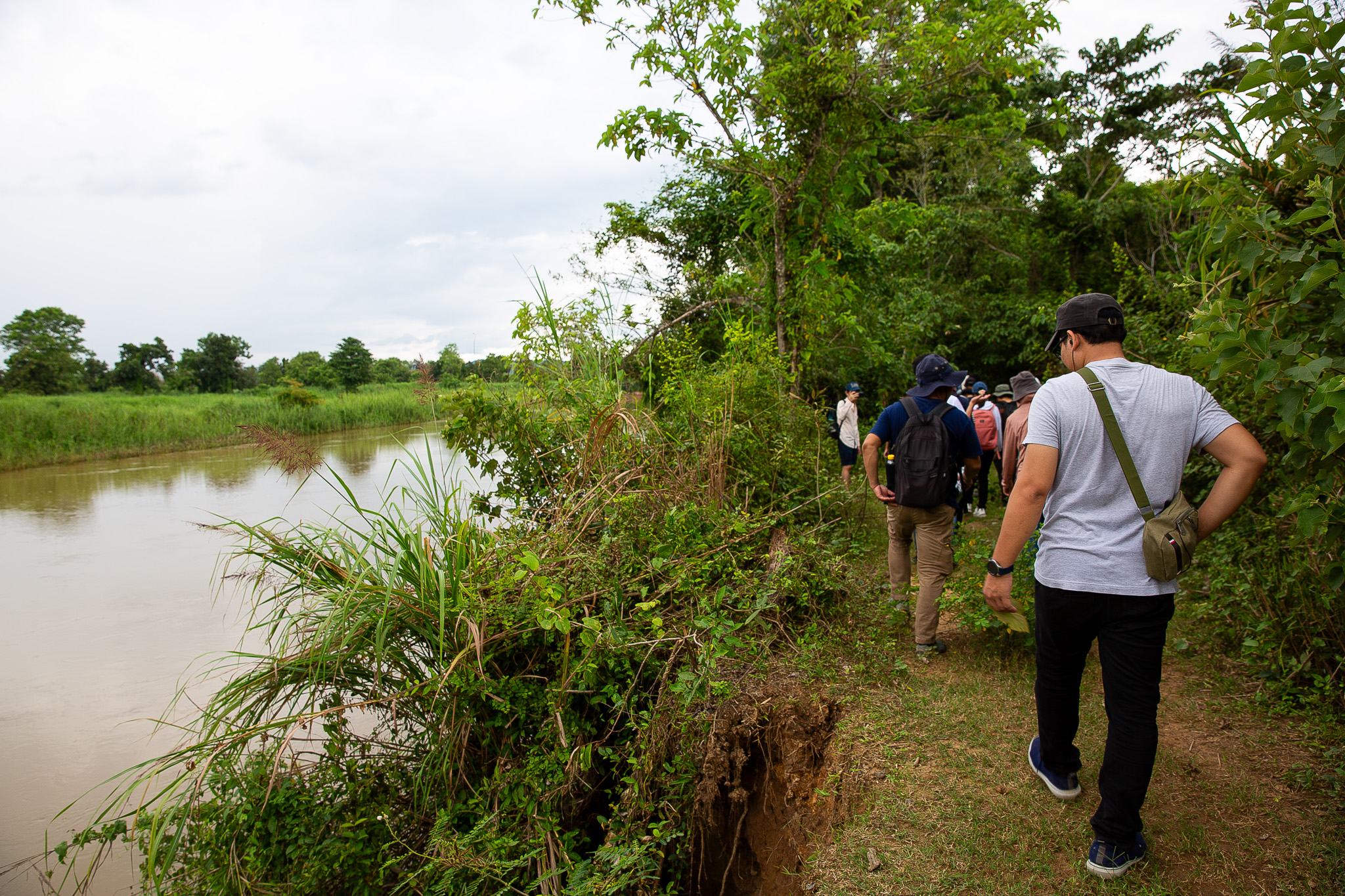
The wetland forest is next to the Ing River, a tributary of the Mekong River. We walked around the forest with Bem, a member of the Boon Rueang Wetland Forest Conservation Group.
Referring to the wetland forest, Bem said the area was previously proposed to become a Special Economic Zone (SEZ). The proposal would involve filling it with compact ground that could lead to losing natural water retention, biodiversity, and some fishing sites, which many villagers rely upon as a source of food and livelihood.
“The villagers opposed and fought back against the planned SEZ. So, our group and other partners collected evidence regarding the wetland forest’s historical records, biodiversity, and its varied benefits to the community. This was to show that industrial development would harm the environment, traditional culture, and livelihood,” added Bem.
Quick Facts: Boon Rueang Wetland Forest
483 hectares wetland forest
Source of livelihood for over 200 families
Generates an estimated $400,000 per year in economic benefits from direct products, including food and raw materials
Bem, a member of the Boon Rueang Wetland Forest Conservation Group, explains the ecological value of the forest.
Their efforts finally paid off. In 2018, the Thai government withdrew the plan to use the wetland forest as an industrial estate. In addition, Bem’s group received the Equator Prize in 2020 from the United Nations Development Programme (UNDP) for its efforts to reduce poverty through the conservation and sustainable use of biodiversity.
Reflections from EarthRights School students
The entire wetland forest covers 483 hectares, and we walked only in the accessible parts. After an hour, we finished the tour. It was raining.
While traveling back to the hotel, I looked back at the learning sessions and discussions we had in the past three days. The journey was transformative. It helped the students and myself to understand the importance of earth rights issues and the impact of development projects on local communities. It’s inspiring to see how local communities are working hard to resist the building of dams and protect their environment and livelihoods.
After the trip, students wrote in their reflection papers on what they learned. One student, Pay, from Laos, mentioned: “Research is vital to show how the development projects have affected society. Evidence can be used in the fight. At the same time, the involvement of the villagers in the research is important.”
Meanwhile, Near from Cambodia is thankful for the hospitality of the communities: “I appreciate their warm welcome, accommodation, and food. The communities have spent their time and efforts to ensure we could be comfortable. I could not thank them enough for that.”
This year, 13 human rights and environmental defenders from Cambodia, Laos, Myanmar, and Vietnam, including six women, are participating in the EarthRights School. From July until November, they will learn various human rights and environmental issues from local and international experts. After they complete the class, many students will lead their communities in fighting against human rights abuses and environmental exploitation.
Boon Rueang Wetland Forest is next to the Ing River, a tributary of the Mekong River.