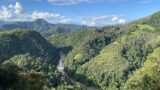
Last year, we blogged about a worrisome plan for a proposed highway/railway project that would traverse the Peruvian Amazon and threaten the lives and livelihoods of indigenous peoples, including peoples living in voluntary isolation. This planned highway/railway, the Interconexíon vial Pucallpa-Cruzeiro do Sol, has been closely watched by a group of indigenous leaders and civil society organizations, called the Grupo Regional de Monitoreo de Megaproyectos de Ucayali.
We were excited to learn that the Grupo de Monitoreo recently launched a new website and blog dedicated to raising awareness around the project and its potential impacts. One of the first stories highlighted on the new website is a recent report published by the Instituto de Bien Común (IBC) which brings together eye witness accounts and testimonials attesting to the presence of peoples living in voluntary isolation in and around the proposed path of the project. Because one of the most common tactics employed by governments to justify the construction of megaprojects that might potentially threaten peoples living in voluntary isolation is to simply insist that they do not exist, and thus no harm can be done to them, this new report and website will likely become critical tools in the struggle against the project.
Here at ERI, we have been closely following two cases, Al-Quraishi v. L-3 Services, Inc., and Al Shimari v. CACI International, Inc., brought by the Center for Constitutional Rights on behalf of detainees of military prisons in Iraq against two private military contractors alleged to have conspired to torture and abuse the plaintiffs at Abu Ghraib and other detention centers. Yesterday we were thrilled to learn that the Al-Quraishi case was resolved in a confidential settlement.
ERI has acted as an amicus in both cases, submitting briefs before the 4th Circuit Court of Appeals arguing in support of the plaintiffs that their claims should be allowed to go forward and that they do not implicate the special “foreign affairs preemption doctrine,” which bars certain claims that interfere with U.S. foreign policy.
Last May, in an 11-3 decision, an en banc panel of the Fourth Circuit dismissed the defendant military contractors’ appeal for lack of appellate jurisdiction and remanded the case back to the district court.
While the Al Shimari v. CACI case will now move forward into discovery before a court in the Eastern District of Virginia (the home district of CACI), the plaintiffs in Al-Quraishi v. L-3 Services, Inc., voluntarily dismissed their claims against L-3 after the case was resolved in a settlement, the terms of which are confidential.
Last week, as human rights groups in the United States prepared for the pivotal case, Kiobel v. Royal Dutch Shell, to come before the Supreme Court, activists, NGOs and victims in India were similarly appealing to their Supreme Court for redress in a major corporate human and environmental rights matter. Many of us will recognize the name Union Carbide Corporation and recall its involvement in the Bhopal plant disaster during which is poisonous gas leak claimed the lives of 5,000 people in 1984. Few of us are aware, however, that the struggle for justice for those who continued to reside in and around the Bhopal plant is anything but over.
In 2004, recognizing that groundwater pollution emanating from the Bhopal plant (which was used to manufacture toxic pesticides) presented serious health risks for the neighboring settlements, the Indian Supreme Court ordered that piped water be supplied to fourteen settlements around the Bhopal site affected by groundwater contamination. Despite that order, NGOs working with communities in the area continued to insist that the groundwater contamination problem was not abating; but rather, worsening, and spreading.
Last week, the Indian Institute of Toxicology Research (IITR) in Lucknow, which had collected 26 samples from around the factory, submitted a report to the Indian Supreme Court stating that toxic chemical waste “left behind by Union Carbide in the factory premises and solar ponds created to dump chemical waste of the factory was said to be causing contamination of underground water due to seepage, particularly during rainy season.”
Even worse, the report found that the contamination had spread from the initial fourteen communities of concern to include four more communities, making for eighteen communities in the vicinity of the Bhopal plant where contamination continues to threaten the health and environs of thousands of people. According to the IITR report, the results of the levels of chlorine and nitrate in the samples were found to be higher than permissible.
Here in the Lima office, we are troubled by two days of violence and arbitrary force reportedly unleashed by the Peruvian police and army against civilians protesting the Conga mine project in Cajamarca.
The contested Conga project, financed by US-based company Newmont, has drawn a renewed wave of popular protest in recent weeks after Peruvian President Humala affirmed that he will give the project the “green light.”
This is despite widespread objection to the proposed gold mine that would require moving four pristine lagoons now serving as water sources for residents throughout the Cajamarca region.
Although the protests have been largely peaceful over the past few weeks, things turned unexpectedly violent yesterday when police reportedly clashed with protesters in Celendin, Cajamarca. Three civilians are reported dead, and many more, injured.
According to local news sources, last night protesters filled the Plaza de Armas in Cajamarca in a silent vigil for the three civilians who were killed, only to be met by a wall of police who fired tear gas into the crowd. The protesters reportedly had to flee into a nearby church for safety. President Humala, in turn, extended the “state of emergency” until July 26 in the zones surrounding the Conga project.
For the people of Cajamarca, the “state of emergency” has come to be associated with criminalization of protest; a suggestion that found support only hours ago when Father Marco Arana, one of the most prominent leaders of the movement against the Conga project was reportedly interrupted during a silent vigil and forcefully detained by the police. As of now, it is not known what charges, if any, have been brought against Arana. But it is reported that he is being denied access to his lawyer.
Last week, here in Peru, all eyes were on the release of the Regulation for implementing the new Ley de Consulta (Law on Prior Consultation for Indigenous Peoples). Precisely because the new prior consultation law and its implementing regulation could present a potential vehicle for halting environmentally destructive and controversial megaprojects in areas that indigenous peoples call home, the law has generated much conversation and debate about when and how prior consultation should take place and who should be consulted. Yet, none of these debates has asked, nor answered, the question of what should happen when the very people who might be affected by a potential project have a right not to be contacted, thereby making prior consultation impossible.
Today, in the Peruvian Amazon, there are believed to be 14 different “pueblos” living in voluntary isolation or in a state of initial contact. As an expression of their autonomy and their history, these groups affirmatively choose to live in voluntary isolation, rejecting sustained contact with members of the national society in order to ensure their cultural continuity and survival. Indeed, the risk of massive health epidemics from contact alone presents a grave and formidable danger. There should be no question that these groups’ decision to remain in voluntary isolation should be respected. This is the case whether one is discussing the potential entry of an oil company into their territory or the seemingly benign endeavors of biologists, anthropologists or explorers who seek to contact or “modernize” these groups in the name of development or progress.
Editorial Note: This morning the U.S. Supreme Court heard oral arguments in Kiobel v. Royal Dutch-Shell, a case which we have blogged about extensively over the past 18 months. Several of our staff members were in attendence, and four of them wrote brief initial impressions. This is one of those four.
One of the most remarkable moments for me, during today's arguments, was when the respondents argued that international law didn’t apply to corporations because the texts of international treaties and conventions didn’t specify that they applied to corporations in particular.
In response, Justice Kagan countered: “well, the text of those conventions doesn’t mention that Norwegians can be sued either, but that doesn’t mean that the Norwegians should be exempt from human rights liability.”
Justice Kagan is exactly right: the norms prohibited under international law are prohibited regardless of who violates them. This is true whether one is “Pirates Inc.” or, in Justice Kagan’s hypothetical case, Norwegian.
The Lago Agrio plaintiffs’ increasingly complex struggle for justice against Chevron, and for a cleanup of their rainforest home, has taken a new turn. Last Thursday, the plaintiffs submitted a request to the Inter-American Commission on Human Rights, requesting precautionary measures to ensure that Ecuador enforces the multi-billion dollar judgment that its courts have rendered against Chevron. The plaintiffs argue that their rights to life, physical integrity, health, fair trial, and judicial protection are being placed in imminent danger as a dispute between Chevron and Ecuador before a private investor-state arbitration panel—in which the plaintiffs themselves are not permitted to participate—threatens to impede the enforcement of that judgment.
Why are the plaintiffs, who have won in the Ecuadorian courts, now going after the Ecuadorian government in the Inter-American Commission? The answer lies in the structure of international law, and the steps that Chevron has taken to abuse its processes and its principles.
Since 2009, Chevron has sought to avoid paying for a cleanup by attacking the Ecuadorian judicial process outside of Ecuador. In addition to asking the U.S. courts to prevent enforcement of the judgment (which a U.S. appeals court recently refused to do), Chevron also appealed to a forum that was likely to be more hospitable to corporations: an international arbitration panel. A treaty between Ecuador and the U.S., known as a Bilateral Investment Treaty (BIT), allows U.S. investors in Ecuador to bring a dispute with the government to a panel of three private arbitrators, who are typically commercial lawyers who serve as arbitrators in a (very well-compensated) side business.
When an Ecuadorean appeals court in Sucumbíos upheld an $18 billion judgment against Chevron earlier this month, I happened to be passing through Lago Agrio—the famed location of the oil contamination at issue in the case. As we took the highway out of town, we followed the path of the oil-pipeline that snakes its way southwest, towards Quito. “The government does more to protect the pipeline than it does to protect drivers,” my guide informed me as we headed east.
I wasn’t surprised. In fact, the purpose of my trip southeast of Lago Agrio was to visit another project that is wholly supported and driven by the Ecuadorian government, and that has little promised benefit for the people, or the forests and rivers, in its path. This project is the massive Coca Codo Sinclair hydroelectric dam.
Anticipated to be the largest hydroelectric project in Ecuador, the dam is highly controversial. The project is estimated to affect more than 2,000 people and flood an area of 3 square kilometers of a delicate Amazonian basin. The project could also potentially bring to a trickle Ecuador’s tallest waterfall, the San Rafael falls. Critics and experts in Ecuador also question the fact that the dam is being bankrolled with a $1.68 billion dollar loan from China to finance 85 percent of the construction and equipment. In turn, the state-owned Chinese company, Sinohydro Corp., was awarded the construction contract in a process that many regard as having been procured without proper bidding.
Last week, Benjamin blogged about the ongoing protests by communities challenging the controversial Conga mining project in the Cajamarca region of Peru. At the time, all eyes were on recently elected Peruvian President Ollanta Humala to see how he would respond to the protesters’ demands that he halt the $ 4.8 billion project—which will pose serious environmental impacts for the surrounding communities.
Late Sunday evening, Humala finally responded. But his response was not what the protestors had been seeking.
After the Administration and leaders of those opposing the project were unable to reach an agreement for resolving the protest, the President decided to take unilateral action, calling on the force of the State. In a televised address Sunday night, President Humala announced that he was declaring a sixty-day state of emergency in four provinces in the Cajamarca region, authorizing the deployment of the Peruvian armed forces to assist local police in the zone, and giving the military sweeping authority. The government, he said, had “exhausted all paths to establish dialogue as a point of departure to resolve the conflict democratically".
This measure is nothing short of extreme, and it raises serious concerns for Peru’s obligations under both international and InterAmerican human rights law. Beyond the deployment of the domestic military against its own citizens, the directive also threatens to suspend critical constitutional freedoms, such as the right to free assembly and travel, for the same 60-day period. In addition, the state of emergency may be used to justify invasive private property searches normally prohibited by the Peruvian constitution; and it could permit arrests without warrants.
This development is a worrisome one, and we will be following it closely from the ERI Amazon office.
One of the great things about working in the new ERI Amazon office is that you get to travel into the Amazon from time to time. Last week, Benjamin and I had the chance to travel and meet with several indigenous leaders in the Ucayali region of Perú to discuss some of the pressing issues their communities were confronting. While we were not surprised to hear about the impact of oil activities in their environs, we were struck by how much people wanted to talk with us about highways—and how they might be able to stop them.
Benjamin blogged earlier this month about the protests by indigenous communities challenging the construction of the TIPNIS highway in Bolivia. But the TIPNIS project does not stand alone. TIPNIS is actually only one piece in a much larger plan that encompasses more than 12 countries and seeks regional integration for energy, infrastructure, and communications This $70 billion plan, called the “Integration of Regional Infrastructure in South America,” or IIRSA, is composed of some 514 projects, including highways, dams, ports, railways, power plants, water-highways and corridors connecting them all. The idea for IIRSA was first launched during a presidential summit in 2000 that took place in Brasilia among South American leaders, but today it is primarily driven, and bankrolled, by Brazil and its National Bank for Social and Economic Development (BNDES).
IIRSA has given Brazil a means for thinking big. As additional highways and waterways are etched across neighboring Ecuador, Perú and Bolivia, Brazil can realize its dream of reaching the Pacific Ocean overland. And Brazil is more than willing to pay. The New York Times noted last week that the spending influence of BNDES has come to dwarf the lending of even the World Bank. This year, BNDES made about $83 billion in loans (a considerable amount of which funds IIRSA projects like TIPNIS) while the World Bank lent only $57.4 billion in comparison. Indeed, the growing influence of the BNDES is not only amplifying the power of Brazil and IIRSA across Latin America, but it is also generating great concern on the part of indigenous communities who lay in its path.
Una versión de nuestro sitio web en español será lanzado a mediados de 2013.
Marissa Vahlsing
Global Human Rights Attorney
Marissa graduated in 2011 from Harvard Law School, where she was awarded both a Henigson Human Rights Fellowship and a Sheldon Fellowship to work with ERI for a year. While at Harvard, Marissa spent two years working as a clinical student on human rights cases involving both international advocacy and federal litigation under the Alien Tort Statute. During this time, Marissa conducted fieldwork and worked with clients in Argentina, Bolivia, Colombia, Ghana and South Africa, and helped to write amicus briefs in several other ATS cases. Marissa holds a B.A. in Political Science from Swarthmore College (2006), where she received a Harry S. Truman scholarship to pursue a career in public service and to work with the International Labor Rights Fund (ILRF) before attending law school.